
Thursday, December 9, 2021

What Animal? A Koala.


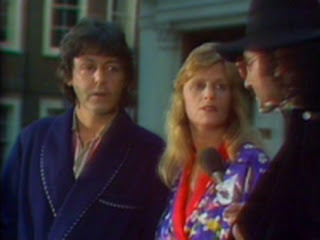
In May 1980, I watched as Father Guido Sarducci stood outside of Paul McCartney's London apartment and tried to get Paul to come out for an interview. According to Don Pardo, it was Paul's 122nd day without marijuana, and it took about three quarters of the show before Paul finally showed up and answered Fr. Sarducci's questions. Of course, all his questions led back to Paul's marijuana usage with the good father continually adjusting the questions to work around Paul's objections. Here is part of the interview 

I only bring up this interview because it a great example of how good interview should work — with the interviewee and the interviewer interacted on a personal level with the interviewer eventually getting to the questions he actually came there to ask. It doesn't work much like this anymore. In fact, most interviews looked pre-scripted and to a large degree are so edited by the time that the viewer sees it they might as well have background music and graphics added, ––no wait that just happened didn't it?

Anyway, I recently got an email from an Internet journalist who wanted to interview me regarding my last book, POMSILv2. Over the years, I've been interviewed several times by various journalists, bloggers, and podcasters and except for the podcaster, most of them are not what I would think of is a real interview. This journalist, like many before her, wanted to send me a list of questions and allow me to pick ten out of the twenty or she sent. Then, I could work on them at my convenience, and send the meticulously edited responses back to her. 

Even though I had done this in the past, I didn't do it this time. What's the point? If I will not be challenged in a give-and-take exchange which explores things I may have included in my answers, am I doing anything more than writing a bit of a selective autobiography? Considering that I'm a writer of fiction, don't I have an unfair advantage going into that? I guess the bigger question is when did we get this lazy about interviews to where they are nothing more than self-aggrandizing promotional opportunities. Sure, the person granting the interview is attempting to drum up interest in their latest project, but at one point we had people interviewing who were skilled enough to find something more in the interaction.
I can remember great interviews I've read or seen over the years where the person conducting the interview actually took the subject into realms they never intended to go into. Sometimes it allowed for fresh revelations about the person being interviewed like Frost's interview of Nixon. Then sometimes the interviewer and interviewee were so diametrically opposed you watched with interest waiting for the fireworks –– Alex Haley's interview of Norman Lincoln Rockwell. If you've ever read a great interview, you walked away with the satisfaction of having learned something new that was unavailable any other way. Now, interviewees are paid millions to regurgitate whatever their publicity manager tells them to say.

I don't know, maybe I was just in a bad mood when I read the request but if I'm going to do an interview, I want to be interviewed not answer a questionnaire. I would advise anyone on the web who is seeking to make a career out of interviewing people to return to the basics and the interaction of one person with another. As I look over the list of questions I was sent, I can see several that would be good openings for someone to ask additional questions clarify and more deeply explore. Unfortunately, those are questions that'll never be asked, given this format.  

FWIW, Goodreads does have a variation of this that I do like.  A single unconnected question from readers, that appear from time to time.  Authors can optionally submit a space limited answer. It is a simple, single bite meant to whet the appetitie. It works.

For now, I will spend the rest of my afternoon mulling over the most interesting question Father Guido Sarducci asked Paul: If you could be any animal, what would you be? So many possibilities, and that simple choice would provide so much insight. Pity I've never been asked that question in any interview.

Note: The point of Paul submitting to an interview was to introduce his new video. Maybe that's why I really didn't respond to the interview request. I don't have a new video to release. Maybe next time.


351,003

Wednesday, November 3, 2021

Silver Wings...Slowly Fading Out of Sight


I stopped for the light, and began flipping through channels on my radio when my ears caught the first few notes of a song from somewhere deep in my past... Silver Wings. 

Silver wings shining in the sunlight;
Roaring engines headed somewhere in flight.

It transported me to my usual table at the Rhein-Main NCO Club with a live band performing the song. It could have been one of many nights I was in the club having a last hurrah with someone who was getting ready to leave for good or maybe just departing for an extended vacation back in the States. Either way, the song always paused the good-time being had and replaced it with the depth of what was happening-- someone was about to get on a plane and leave the rest of us behind.

They’re taking you away, leaving me lonely;
Silver wings slowly fading out of sight.

When you’re doing a military overseas tour, everyone usually comes and goes via an airplane, which leads to it becoming a weighty symbol of eventual departure. I knew many folks who had countdown calendars on their wall that prominently featured an aircraft taking off. It served as the last element of your tour–the plane hitting the sky.

People flowing in and out of an overseas base is constant, resulting in a string of gatherings to say hello and goodbye. The hellos were mostly just functionary — trying to get to know someone new. The farewells take an emotional toll as someone you’d grown to rely on was going to vanish. It’s hard to understand an environment that lacked social media and instant email unless you actually lived in it. The only means of communication we had were very expensive phone calls or writing letters that took both time and effort.

“Don’t leave me,” I cry;
Don’t take that airplane ride.
But you locked me out of your mind;
Left me standing here behind.

How Silver Wings became a tradition at farewell parties is easily understandable. The lyrics are simple and the music too -- one verse, one musical bridge, and a chorus that repeats three times. It would pierce the psyche, then burrow deep. The song would momentarily pause the joy and leave nothing but raw emotion as you said goodbye to somebody you cared about, someone whose presence you came to rely on. In the end, the only thing left was watching their plane fading away in the sky the next morning. 

Luckily, the song is short enough that it ends before the emotion of the moment overcomes you but it’s long enough to hear a few whispered words from the person leaving that you’ll never forget. Perfect.

Hearing Silver Wings now brings back those memories along with a sting of the blues, as I think about the people I bid farewell. Except for one person, who ended up transferring into my last duty station during my last year of service, I never ran into any of those people again. But who knows what tomorrow holds? Besides, melancholy over the past is proof that you lived a full life rather than one that was emotionless.

Slowly fading out of sight.


There was one other song I vividly remember as a tradition from those days, but Waitress, Oh Waitress brings more laughs than introspection.


347,590

Wednesday, September 22, 2021

Trek A Mile on My Wheels


On my birthday, I went to Walt Disney World. Sometimes when a man reaches a certain age, he just has to ride Space Mountain repeatedly. This entry isn’t to comment about the actual visit, but something that happened during that visit which has led to an empathetic epiphany.

For a few years, I’ve had an issue with my left ankle. A few months ago, I finally got to the right orthopedic specialist who, thanks to fresh x-rays and a different viewpoint, informed me that the issue I have will continue to degrade the rest of my life without some sort of surgical intervention. Not exactly glorious news, but at least I knew what I was dealing with after speaking with him. Because of the ankle, I have issues walking long distances and sometimes have to take several breaks due to pain or stiffness.

After the first two days at Disney World, in which I clocked almost fourteen miles according to my Fitbit, I decided to rent an electric convenience vehicle (ECV), rather than continuing to suffer. ECVs have become more and more prevalent as the costs have gone down and battery longevity went up. There is a massive variety of these vehicles available, but as you might expect the ones that are rented out by WDW are the most basic model available.

Within minutes, I realized that even at maximum warp; the ECV was still at least a half step slower than the walking speed of the average Disney going adult. As a result, I had a continual flow of people on both sides as they passed my slow-moving vehicle. While I had no problem being passed by, it quickly made me feel like I was a hindrance to normal pedestrian traffic. I realized the unintentionally, I stuck to lesser used pathways to avoid the issue. This, of course, made me even slower because of the reasons those pathways were lesser used.

A common complaint that I have heard wheelchair users have is the feeling that everyone is looking down on them because of the height difference between the wheelchair and everyday societal life. The same is true of ECVs. When I needed to talk to someone, I usually attempted to stand up and straddle the vehicle so that I was talking to them I eye to eye. It was a luxury I had that most people in the same situation did not. I was trying to normalize the status I found myself in. 

No matter how nicely the Disney cast members asked me if I could transfer from the ECV to a ride without assistance, I could always see people’s the facial expressions behind them. I was quick to point out that I could transfer without intervention. Somehow, I felt the need to belay the fears of the surrounding people who may have thought I would slow down their own access to the ride. Quick note here: WDW is great in the way it handles access for people with special needs and we should commend them. Since my issue was walking long distance and standing for extended periods, I did not use those accommodations because they did not apply to me.

Of course, the issues encountered were not all mine as I found that a vast majority of the people who walked past me when I was going slower had no issues suddenly stopping directly in front of me without warning. This happens as a pedestrian all the time, and fortunately most of us are agile enough to readjust our path to avoid a collision. It is not so easy and ECV that does not have active breaking nor turn on a dime steering. I think I avoided hitting anyone, but it was close many times. Just as bad were those folks who saw fit to cross directly in front of me without consideration that they might find themselves run over just as they would if they suddenly crossed the street in front of a moving car.

Texting while driving is unsafe. Texting while walking in an environment that includes ECVs is worse. I actually had a pedestrian collision because they were texting and walked directly to the side of the ECV. If we were both pedestrians, it might have resulted in a slight bump. However, when hitting several hundred pounds of ECV, the ECV will usually win. This time, it caused them to fall over on top of me and almost flip the vehicle over. I forgot to ask if their Instagram post was okay after the wreck.

The ECV served his purpose; it got me around and rather than dealing with sleepless nights because my ankle ached; I slept pain free. The lasting effect of using an ECV was to make of the challenges folks who use these or wheelchairs daily face clear to me. I know I’ve probably stepped around the wheelchair or ECV in life without a care as to how it might affect them. Likewise, I have probably stepped in front of someone unconcerned about their ability to stop or quickly maneuver their mechanical conveyance. Worst of all, I’ve probably watched as they made an inquiry about the necessity for help while allowing my expression to convey disdain openly.

We’re better than this. All we need to do is realize that the person on wheels is simply trying to function in society. We just need to know that we need to slow down around these conveyances and realize it does not hurt us just because someone needs a little extra help from time to time. 

They are not trying to take advantage. They’re simply trying to take part.


BTW, the new Star Wars section of the park is terrific.


345,752

Wednesday, August 11, 2021

POMSILv2 Now Available


An anthology of stories selected to provide you with a brief escape from where you find yourself right now. Each will allow you to leave this reality and take a quick trip into someplace completely different. Have no fear. It's a nice place, and whether in the past or another world, it's okay, they know you there.

The stories featured in this volume:

I Only Slow Dance

Rafe, a ninth-grade military brat, finds himself at the first dance of the school year in a new locale. Having made no friends and yearning to belong, he is befriended by fast-talking and slightly flirtatious RenĂ©e, who shatters his wall of loneliness, daring him to resist her charm.  As the music plays, Rafe finds himself attracted to this siren. Before the last note, they enjoy a first kiss that becomes a lifelong memory, but is the memory of that explosive first kiss one that matters?

Beyond AM Radio

When Cordeil starts a new job, he discovers an antique car radio he needs to finish restoring his 1947 Cadillac. It might be perfect, but it is stored in a strictly controlled government warehouse, and taking it would be a federal crime. Over time, Cordeil convinces himself that since the radio has been sitting there for half a century untouched, stealing it will do no harm. Unbeknownst to him, he will not realize the true cost of his decision until he powers it up for the first and possibly last time.

DD603

His father brought the AK-44 back from Vietnam as a war trophy.  Now that his father is gone, he has been taking the rifle to the range, hoping to find Zen in shooting targets. Instead, with every cartridge he loads into the breach and every bullet he sends downrange, he finds himself delving into the history of the complex relationship he and his father shared since the rifle was thrust into their midst.  As he fires the last twenty shells, he tries to decide what to do next with the war trophy that has become a painful reminder of their shared past.

It's Said, Destiny Awaits

Just out of the military, Daniel's life is at a significant turning point. Still, it seems like prospects for his next steps are vaporizing before him until a missed turn presents a possibility. Boarding the riverboat Queen Orleans, he sets sail toward a different future where new acquaintances teach him the skills needed to thrive in the place where he finds himself. When your present has no future, maybe it's time to pull on your boots, reshuffle the deck, and step into the past.


332,921

Monday, June 28, 2021

Desktop Toys as Muse


When I finished Three Paperclips & a Grey Scarf, I described it this way:

"Evan Davis takes a three-month assignment as a press embed in Afghanistan. Before departing, a friend hands Davis a hastily gathered good luck charm: three paperclips. Over the months in country, he gets to know the men of a small team of US soldiers with whom he is deployed and rediscovers his muse writing about their experiences in Central Asia for a truth-hungry American public."

But when I started writing, it was a bunch of unconnected but interrelated stories that I had come up with during my deployments to the Middle East. Same with characters that would eventually grace the story, they were all real people I had met along the way. A side note, even though I refer to it as a novel, it is a novella, based on the total number of words. 

Writing it was quick because most of the story had been developing and simmering in my mind for over a year.  But the book has several scenes that involve a dozen or more characters, all interacting with each other. Unfortunately, I kept losing track of where people were in my drafts, and I’d have to go back through the manuscript to track each person individually. I couldn’t have one mysteriously show up somewhere they couldn’t possibly be. Eventually, I came upon the idea of using little plastic soldiers and putting labels on them to track where everyone was. This was especially important during the battle scenes within the story.

At the center of Three Paperclips & a Grey Scarf are two Humvees used by Evan Davis and the soldiers to get around Afghanistan. When I was at the Base Exchange in Kuwait, I saw a toy Humvee and picked it up. From that point on, it sat on my desk. I occasionally pressed into service as I tried to figure out vantage points where action worked within the vehicle. Of course, this was backed up by research on actual Humvees that I could get access to and crawl around in and on.

Without realizing I was creating a precedent, I started something that has become a habit with every story of length that I write. There is always one thing within the narrative: one inanimate object that sticks with me and represents the story in my mind and imagination. While working on the first draft, I will pick up that item and then sit on my desk as I write. I like to think it keeps me focused, but it is probably more of a distraction that I play with when I should be writing. Of course, that doesn’t always work out well, as I’ll tell you about when I talk about the object I picked up for Blood Upon the Sand.

Now you know one of my writing secrets and why I have so many disconnected and unrelated objects sitting around my writer’s lair. At some point, they were all catalysts for my imagination, and they are occasionally pressed into service when I need to take a break.


313,787


Tuesday, May 4, 2021

Passed Away, After a Long Illness


The loss of a loved one is always a deeply felt personal tragedy. Anyone aware that you have suffered that loss expects and allows for a period of grieving afterward. It’s expected and allowed by societal norms. But when that passing is preceded by a long and debilitating illness or a slow walk downhill lasting two weeks or months, those who mean well often forget to adjust their expectations, failing to realize that you've been mourning in preparation for the end for months.

As my father's mental and physical health deteriorated, there were fewer familiar moments I spent with him; moments that were representative of the man I'd known my entire life. It wasn't his fault. It was the disease that gripped him and slowly turned him. Such is the frailty of the human body. But when his passing finally occurred, it was almost a sense of relief and joy that he was no longer slowly tortured as he eventually succumbed. Then I was gripped by a feeling of guilt for being so heartless without realizing that I had been mourning him all through the months prior, and now the moment came for an expected eventuality to pass.

I have to wonder about those who were not part of my immediate family, not witnessing the level of grief they expected or at least grief with which they were familiar. Everyone was polite enough not to ask if they did have questions. Still, suppose they were not familiar with the situation or had not been through it themselves. In that case, I guess they would at least have some questions as to why my period of mourning was not more emotional.

I recently found out someone I know was going through something similar. They were the caregiver to a parent who was at the end of that long hard road. I could say lots of things to them, but rather than going into that, I chose to give them some advice I wish someone had passed on to me -- you have been preparing for this moment for a long time. All through that preparation, your emotions have been at work, allowing you to mourn as the person you knew slowly faded away. Now that it has occurred do not feel guilty that you are not having the expected level of emotion. You have been mourning them for a long time, and no one else except you will realize how painful this has been for you. Instead, use your energy to maintain and solidify all of the good memories you carry in your heart.

For those of you who've been lucky enough not to have undergone something like this, I can only tell you that the best thing you can do is to let the person who experienced the loss guide you. They will tell you their level of pain or feeling and how you can support them. If they don't say it out loud, be silent and let your presence serve as the support they need at that moment.


296,428

Sunday, April 4, 2021

Jesus Christ Superstar - Music For A Lifetime & Beyond

 
At the tail end of sixth grade at St Mary's Catholic School, Father Schwartz walked into Friday's religion class carrying a record album in a brown matte cover. He was very excited and immediately launched into an enthusiastic explanation about why he wanted us to hear this music. As he placed the album on a turntable, Fr Schwartz explained that a way of asking people what was going on was to ask them, "What's the buzz?". We all looked at each other, more than a little confused. He dropped the needle on Side A of album One. I first heard the music from the Original Cast Recording of Jesus Christ Superstar. I was electrified.

It was the first time I heard electric guitars and a symphony orchestra playing together. The music was dynamite, but I was the only one in class who was excited about it. When the class was over, I told Fr Schwartz I liked what I had heard, and he handed me the album telling me to bring it back to him on Monday unharmed.

As soon as I got home, I went directly to the only real stereo record player in the house, put on the headphones, turned the volume up, and spent the next hour and a half listening to those records. I played to the rock opera at least six times before recording it onto cassette before returning the records to Fr Schwartz on Monday. After I returned the album, the only downside was that I no longer had a copy of the libretto to read along with while listening to the music. Later that week, I finally convinced my dad to take me to a music store to buy the sheet music and libretto. The only explanation I ever gave him was that it was an opera, and it was religious. I guess that was good enough.

My relationship with the music of that Andrew Lloyd Webber and Tim Rice classic became my first musical obsession. But there was so much more. There was, after all, the religious aspect. This music covered the last days of the life of Jesus Christ up to the crucifixion. There was controversy over the music, with many mainstream churches objecting to the story being turned into a rock opera. Not surprisingly, more than one faith banned the piece from being listened to by their parishioners. It was also the time of cult growth, so people were scared of the unapproved. Even though I was introduced to the music by a Catholic priest, it did nothing to convince me that organized religion was the way to go. Due to the objections over the way the story is told in JCS, I had an epiphany that the purest faith existed outside of organized religion rules. For a sixth-grader, this was a pretty bold conclusion.

As I continued to listen to the music on repeat, I memorized all the words and no longer needed the libretto to guide me. The words came from the Bible with few liberties taken here and there to update them without changing the story. Of course, then, just as now, people seem determined to project their meanings into anything anyone else says. Before the movie came out, I recall an argument in eighth-grade shop class between myself and a Baptist minister's son. He asserted that the JCS story implied there was a sexual relationship between Jesus and Mary. In the end, I concluded that anyone who wanted to find sexuality in anything could if they look hard enough. Mary and Jesus had a complicated relationship not due to sexuality but due to her faith and who he was. Mary's song I Don't Know How to Love Him is not about romantic love but her confusion that the only love she understood was something completely different from what she was feeling now.

I was one of four people in the theater on the day the film version premiered at the movie theater in Lawton, Oklahoma. From the minute the theater went dark, and the music started, I was enthralled. For the first time, I could see what the story looked like rather than just playing it out in my mind as I listened to the music. Norman Jewison brought a unique viewpoint to the movie I never imagined. Ted Neeley, Carl Anderson, and Yvonne Elliman's performances were captivating and defined those roles for me for the rest of my life. As soon as I could obtain a copy of the movie, it became an annual viewing ritual.
I find it difficult to watch the movie without feeling deep emotion. The emotion is not only because of the film's spiritual nature but also because of when I was introduced to it. Those years are when a person defines a lot of who they become as an adult. Aside from divine guidance, the movie provided me with an escape anytime I found the real-world overwhelming. The music and words were constant no matter what challenge or question I was facing. 

The movie version contained two additional songs, one of which was Could We Start Again, Please?. The piece is a simple request to return to where they started from Peter and Mary that comes after Jesus' arrest. Even though I call the song simple, it is pretty powerful. Those lyrics, especially the second verse, provided me with great comfort during the tumultuous years of adolescence when sometimes I was the one who had gone a bit too far.

As I have aged and the movie has not, I find myself noticing different nuances every time I see the film. Roman guards continually seem to be present and threatening in every scene, just inside the frame. When all Apostles are seated for the Last Supper, the brief freeze of position is an homage to da Vinci's painting. During my last viewing, I noticed the other Apostles' effort to try and keep Judas within their fold as he pulled away and eventually betrayed Christ.

On Good Friday of 2007, I was able to see a performance of JCS life. This was Ted Neeley's farewell tour and included Corey Glover from In Living Colour as Judas. Unlike the theater when I went to see the movie version back in 1973, this theater was packed and energetic. The performance was amazing.

Recently, John Legend leading a new cast of actors, presented JCS as a live performance on TV. I still haven't seen it, so I can't speak to it, but I'm glad that it was redone for a new generation of viewers. The story is timeless. The music is still good. The rock opera provides unique access to the greatest story ever told the folks who might not have otherwise been aware of it.

The performer side of me always wanted to do this rock opera. Even though the best songs belong to Judas, the role I wanted was Pontius Pilate. As created by Tim Rice, the character changes from a man who didn't want to be bothered with this bit of trouble in the occupied territory he was governor of to one who realizes who he was being called on to condemn. It is a powerful transformation.

If you are not familiar with the music or have not seen the movie or a performance, I would heartily recommend it. It is perfect for the Easter season. Father Schwartz:  Thank you for turning me on to Jesus Christ Superstar!


288,381